How to stop procrastinating as a student
You know the assignment is due on Friday. You open your laptop on Monday, then decide to tidy your desk, check one message and watch one short video. Suddenly it is Thursday night. If this sounds familiar, you are not lazy. Procrastination is usually an emotional problem, not a time problem. Why we procrastinate We avoid tasks that make us feel uncomfortable: anxious, bored, confused or afraid of doing badly. Reaching for the phone gives instant relief. That relief feels good for a moment, then guilt arrives, the task feels even heavier, and the loop repeats. Knowing this changes the solution. You do not need more willpower. You need to make starting easier and distraction harder. Find your reason The task is too big: “I do not know where to start.” Break it into a first step that takes under 10 minutes. The task is unclear: “I am not sure what they want.” Re-read the brief or ask your lecturer or a classmate today. Fear of failure: “What if it is not good enough?” Aim for a rough draft, not a perfect one. The task is boring: pair it with a reward, a study partner or a pleasant place to work. The deadline feels far away: set your own earlier mini-deadlines. Make starting ridiculously easy The two-minute start. Promise yourself just two minutes. Starting is the hardest part, and once you begin you will usually keep going. Name the next physical action. Not “do the essay” but “open the document and write three bullet points for the introduction”. Prepare the night before. Leave the book open at the right page and your notes on the desk. Decide when and where. “After lunch I will sit at my desk and do 25 minutes of physics” works far better than “I will study later”. Make distraction harder Your phone is designed to capture attention, and fighting it with willpower alone is an unfair fight. Change the environment instead: put the phone in another room while you study, turn off all non-essential notifications permanently, close every browser tab you do not need, and keep a “distraction list” beside you. When you think of something to check, write it down and deal with it in your break. Use a timer Working in short, focused blocks with real breaks, the Pomodoro Technique, gives your brain a finish line. “Focus for 25 minutes” is far less scary than “study all evening”. Be kind to yourself Research suggests that students who forgive themselves for procrastinating tend to procrastinate less next time, because the task feels less loaded with guilt. Missed a day? Do not wait for Monday or a new month. Start again with a tiny version of the task today. Try it now Use the free Pomodoro Timer, then go deeper with Productive Student, the illustrated guide with a 30-day plan and printable worksheets. You can read the first chapter free.
The Cornell note-taking method explained, with an example
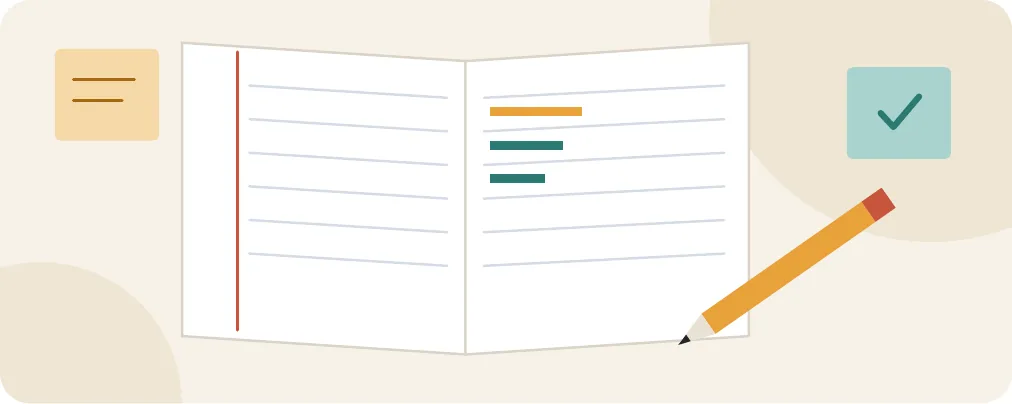
Many students write down almost every word a lecturer says, then never look at those notes again until the week before the exam. By then the pages are a wall of text that is hard to revise from. The Cornell Method fixes both problems: it makes you think during the lecture and it turns your notes into a ready-made practice test. How to set up the page Divide each page into three parts: Notes column (right, about two-thirds of the width): main ideas, examples and diagrams, written during the lecture in your own words. Cue column (left, about one-third): key questions and keywords, written after the lecture. Summary (bottom strip): three or four sentences summarising the whole page, also written after the lecture. During the lecture Write in the notes column only. Listen for structure: “there are three causes”, “the key point is”, “this will be in the exam”. Use short phrases, abbreviations and quick sketches. If something confuses you, put a question mark next to it so you can follow up. After the lecture (the same day) Read through your notes and fix anything unclear. In the cue column, write a question for each main idea. For example, next to notes about photosynthesis, write “What are the inputs and outputs of photosynthesis?” Write a summary at the bottom in your own words. This takes about 15 minutes, and it is one of the best-value 15 minutes in your week, because reviewing material within a day greatly improves how much you keep. How to revise with Cornell notes Cover the notes column with a sheet of paper. Read each question in the cue column and answer it out loud or in writing. Then uncover the notes and check. This is active recall, the most effective revision method there is, and your notes have set it up for you automatically. A quick example Lecture topic: the water cycle. Notes column: “Evaporation: sun heats water, becomes vapour. Condensation: vapour cools, forms clouds. Precipitation: rain, snow. Collection: rivers, lakes, ground water.” Cue column: “What are the four stages of the water cycle? What causes condensation?” Summary: “The water cycle moves water between land, sea and sky through evaporation, condensation, precipitation and collection, driven by the sun’s energy.” Paper or laptop? Both work. Handwriting tends to force you to summarise, which helps understanding. A laptop is faster and easier to search. Whatever you choose, keep all notes for one course in one place and leave room on every page for cues and a summary. Try it now Use the free SMART Goal Builder, then go deeper with Productive Student, the illustrated guide with a 30-day plan and printable worksheets. You can read the first chapter free.
SMART goals for students, with examples

“I want to do better this term” is a wish, not a goal. It has no deadline, no measure and no clue about what to do on Tuesday afternoon. Good goals give you direction, help you decide what to say no to and make your progress visible. The SMART framework is a simple test that turns a wish into a real goal. What SMART means Specific: clear about exactly what you will achieve. Measurable: you can tell when you have done it. Achievable: ambitious but realistic for your time and starting point. Relevant: connected to something you really care about. Time-bound: it has a deadline. Examples: from wish to SMART goal Wish: “Get better at maths.”SMART goal: “Score at least 70% in my end-of-term Mathematics exam on 12 December by completing two past papers every week.” Wish: “Read more.”SMART goal: “Read one set book chapter every weekday evening for 20 minutes until the end of November.” Wish: “Pass my certification.”SMART goal: “Pass the networking certification exam by 31 March by studying 6 hours a week and scoring 80% or more on three practice tests first.” Wish: “Stop cramming.”SMART goal: “Start every assignment within two days of receiving it, every week this semester.” Use the goal ladder A big goal becomes manageable when you break it down into four rungs: a long-term goal (one to four years), a term goal, a weekly goal and a daily action. If you always know your next daily action, the long-term goal looks after itself. Outcome goals and process goals “Get an A in Biology” is an outcome goal; it gives direction but is not fully in your control. “Do 30 minutes of active recall on Biology five days a week” is a process goal, and it is completely in your hands. Set one outcome goal per subject, then attach one or two process goals and track those every day. Do not set too many If everything is a priority, nothing is. Limit yourself to three main goals per term, usually one academic, one personal or health goal, and one career or skill goal. Write them where you will see them every day and review them every Sunday. Try it now Use the free SMART Goal Builder, then go deeper with Productive Student, the illustrated guide with a 30-day plan and printable worksheets. You can read the first chapter free.
How to use the Pomodoro Technique for exam revision
You sit down to revise for three hours. Forty minutes later you have checked your phone eleven times, re-read the same page twice and made a beautiful timetable you will never follow. The problem is not that you are lazy. Long, shapeless study sessions are hard for anyone to sustain. The Pomodoro Technique fixes that by giving your revision a rhythm. What the Pomodoro Technique is The method is simple: you work on one task for 25 minutes, then take a 5-minute break. Each 25-minute block is called a “pomodoro”. After four pomodoros you take a longer break of 15 to 30 minutes. That is it. No app or special notebook is required, though a timer helps. It works because it changes the question you ask yourself. “Can I revise Chemistry for three hours?” feels heavy. “Can I focus on these practice questions for 25 minutes?” feels possible, so you start. And starting is the hardest part of any study session. How to set up a Pomodoro revision session Choose one specific task. Not “revise Biology” but “answer the 2023 past-paper questions on photosynthesis”. A clear task stops you wasting the first ten minutes deciding what to do. Remove distractions before you start. Put your phone in another room or in a bag on silent. A phone face-down on your desk still pulls at your attention. Start the timer and work only on that task. If a thought pops up (“I need to reply to Brenda”), write it on a scrap of paper and return to work. You will deal with it in the break. Take the break properly. Stand up, stretch, drink water, look out of the window. Do not open social media; five minutes of scrolling rarely stays five minutes. Count your pomodoros. Tally them in your notebook. Seeing “6 pomodoros today” is motivating, and it shows you how much focused work you can really do in a day. Make every pomodoro count A timer only protects your focus. What you do inside the 25 minutes decides whether you remember anything on exam day. The most effective revision methods are active, not passive: Active recall: close the book and write everything you remember, then check what you missed. Past papers: answer real exam questions under time pressure, then mark them strictly. Flashcards: question on the front, answer on the back, reviewed over several days. Re-reading and highlighting feel productive but are much less effective. A good rule: at least half of your pomodoros should involve testing yourself. Adjust the rhythm to suit you 25 and 5 are a starting point, not a law. Some students prefer 50 minutes of work with a 10-minute break once they are used to focusing. If 25 minutes feels too long at first, start with 15. What matters is the pattern of focused effort followed by real recovery. Many students find their hardest subject works best in the morning, when their energy is highest. Track your focus for a week and plan your toughest pomodoros for your sharpest hours. Common mistakes Skipping breaks. Pushing through feels heroic but your focus fades. The break is part of the method. Vague tasks. “Study” is not a task. “Summarise chapter 4 from memory” is. Multitasking. Replying to messages between questions breaks the whole point of the technique. Planning but not starting. Do not spend a pomodoro decorating your timetable. Spend it on questions. A sample evening Here is what two hours of revision might look like for a student with a Mathematics exam in three weeks: pomodoro 1, ten past-paper questions on algebra; pomodoro 2, mark them and redo the mistakes; pomodoro 3, flashcards of formulas; pomodoro 4, a timed section of a full paper. Then a long break. Two hours, four clear wins, and no time lost wondering what to do next. Try it now Use the free Pomodoro Timer, then go deeper with Productive Student, the illustrated guide with a 30-day plan and printable worksheets. You can read the first chapter free.
Active recall vs re-reading: why testing yourself works better

Most students revise by reading their notes again and again. It feels responsible, and after the third read the pages look very familiar. Then the exam starts, and the answer that looked so familiar on the page will not come out of your head. Learning researchers call this the illusion of competence: recognising information is not the same as being able to recall and use it. What active recall is Active recall means pulling information out of your memory instead of putting it back in. You close the book and ask yourself: what do I actually know about this? Every time you successfully retrieve a fact or idea, the memory becomes stronger and easier to find next time. Every time you fail, you discover exactly what you need to study. Both outcomes help. Why re-reading feels better but works worse Re-reading is smooth and comfortable. Nothing goes wrong, so it feels like progress. Active recall is uncomfortable because you notice the gaps. But that effort is the point. The struggle to remember is what tells your brain this information matters. Easy study often leads to weak memories; effortful study leads to strong ones. Five ways to use active recall The blank page test. After a lecture or chapter, take a blank page and write everything you remember for ten minutes. Then open your notes and fill the gaps in a different colour. The second colour is your study list. Turn headings into questions. “Causes of the First World War” becomes “What were the main causes of the First World War?” Answer it before you read. Flashcards. Write a question on one side and the answer on the other. Say or write the answer before you flip. Past papers. They are active recall in exam format. Do them early, not only in the final week. Teach someone. Explain a topic to a friend, a sibling or an empty chair. Wherever you get stuck, you have found a gap. Combine it with spaced repetition Active recall is even more powerful when you spread it out. Review a topic the day after you learn it, then after 3 days, a week, two weeks and a month. Each review takes less time than the last because the memory is getting stronger. Cramming everything into one night may get you through tomorrow morning, but most of it will be gone within days. What a good study session looks like A simple rule: if your session did not make you retrieve information from memory, it probably was not as useful as it felt. Aim to spend at least half of every session testing yourself. For example, 10 minutes reviewing yesterday’s flashcards, 25 minutes on practice questions, 10 minutes checking answers and writing corrections, and 10 minutes doing a blank-page summary of today’s topic. But what about reading? Reading still has a place. You need to understand material before you can recall it. The change is in what you do next: read a section once carefully, then close the book and test yourself, instead of reading it four more times. Use reading to learn and recall to remember. Try it now Use the free Exam Revision Planner, then go deeper with Productive Student, the illustrated guide with a 30-day plan and printable worksheets. You can read the first chapter free.
How to make a revision timetable you will actually follow
Almost every student has made a revision timetable. Colourful, ambitious, perfectly balanced. And almost every student has abandoned one by the second week. The problem is usually not discipline. It is that the timetable was built for an imaginary student with unlimited energy and no surprises. Here is how to build one for the real you. Step 1: Start with the date and the syllabus Write your exam date at the top of the page and count the weeks you have left. Then list every topic in the syllabus for each subject. Use the official syllabus or past papers, not just your notes, so nothing is missed. Step 2: Rate your confidence Next to every topic, write a score from 1 to 5. One means “I am lost”; five means “I could teach this”. Be honest. This list is your most important planning tool, because your revision time should go mostly to the topics rated 3 or below. Students who revise in textbook order often spend hours polishing topics they already know. Step 3: Count your real hours Look at an ordinary week. Subtract classes, travel, work, family duties, meals and sleep. How many hours are actually free? Be realistic and plan to use about 80% of them. The other 20% is buffer for the things that always come up. Step 4: Divide the time by weakness Give each weak topic more hours than each strong topic. A simple method: weight each topic as 6 minus its confidence score, so a topic rated 1 gets five times the time of a topic rated 5. Our free Exam Revision Planner does this calculation for you. Step 5: Plan the phases Six to four weeks before: work through your weakest topics with active recall and practice questions. Four to two weeks before: cover every topic and begin timed past papers. The last two weeks: full past papers under exam conditions, strict marking and a mistakes log. The final days: light review, flashcards and plenty of sleep. No big new topics. Step 6: Put sessions in your calendar A to-do list says what; a timetable says when. Write “Tuesday 4:00 to 5:30 pm: Chemistry, organic reactions, past-paper questions” instead of “revise Chemistry”. Put your hardest subjects in your highest-energy time of day, and mix two or three subjects in a day rather than one subject for a whole day. Step 7: Review every Sunday Spend 20 minutes each Sunday comparing what you planned with what happened. Update your confidence scores. Move topics that improved down the list and give more time to the ones that did not. A timetable is a living plan, not a contract. Why timetables fail, and how to avoid it Too much in one day. Six hours planned, two hours done, guilt, give up. Plan less and finish it. No breaks or rest days. Plan at least one half-day a week with no study. Passive revision. Hours of re-reading feel busy but move little. Fill your sessions with questions. Missing a day and quitting. Missing once is normal. Never miss twice: get back on the next day. Try it now Use the free Exam Revision Planner, then go deeper with Productive Student, the illustrated guide with a 30-day plan and printable worksheets. You can read the first chapter free.